
Careers today are more globally connected than ever. Individuals collaborate with people around the world through technology, work in multinational teams, and access career pathways that were previously geographically limited.
Yet while opportunities have become global, meaning has not.
The same work opportunity can carry very different meanings and desirability depending on cultural background, social expectations, and personal history. This is because career decisions are not made based on opportunity alone, but take into consideration values, which are greatly influenced by culture.
As individuals are exposed to an increasingly wide range of possibilities, the way those possibilities are evaluated is not universal. The same role may carry very different meanings depending on cultural context, lived experience, and social expectations.
Understanding how culture shapes work values is therefore essential for interpreting career behavior in a global context.
At the center of this interpretation process are work values, and understanding how they develop is essential for interpreting career decision-making in a meaningful and culturally responsive way.
Work values can be understood as the criteria individuals use to evaluate what makes work desirable, meaningful, or appropriate. Building on the work of Donald Super, they reflect preferences that guide how people assess different work environments and opportunities over time.
While most individuals relate to many of these dimensions, the way they are prioritized differs significantly, and it is this prioritization that most strongly influences career decisions.
Importantly, work values are not formed in isolation. Before individuals ever make an explicit career choice, they are already developing assumptions about what “meaningful work” looks like.
It can therefore be useful to pause and reflect: where do these assumptions come from?
For most people, work values are not consciously selected. They emerge gradually through exposure to cultural norms, family expectations, educational environments, and early work experiences. Over time, these influences shape what individuals perceive as realistic, desirable, or meaningful in their careers.
Broadly, three interrelated forces contribute to the development of work values.
The first is cultural context, which shapes societal expectations around work, success, and identity. Cultural environments influence whether values such as independence, stability, prestige, or collective contribution are emphasized or normalized.
The second is social and relational influence, including family expectations, peer norms, and educational systems. These environments often reinforce particular ideas about acceptable or successful career paths.
The third is personal experience, including internships, part-time work, role models, and both positive and negative experiences in work environments. These lived experiences often refine or reinforce earlier value orientations.
Together, these influences create a system through which individuals develop and refine their work values over time.
Super’s Life-Span, Life-Space theory adds another important dimension to this understanding by emphasizing that work values are not static. Individuals move through multiple life roles—such as learner, worker, spouse, and parent—and the importance of these roles shifts across the lifespan.
The Life Rainbow provides a useful way of visualizing how these roles interact and change over time. In some cultural contexts, certain life roles may be emphasized earlier or more consistently, while in others, career development may be more central during specific life stages. This highlights an important point: career development always exists within a broader system of life roles, not in isolation from them.
When examining work values across different regions, it is important to approach interpretation with care. The data referenced here is drawn from large samples of assessment results from high school students across major urban areas in China and the Philippines, as well as a multi-city sample in the United States. While these patterns offer useful insight into value prioritization among young people in different contexts, they should not be interpreted as fixed cultural characteristics. Rather, they reflect patterns within specific populations at a specific point in time.
Across these contexts, several interpretive patterns emerge.
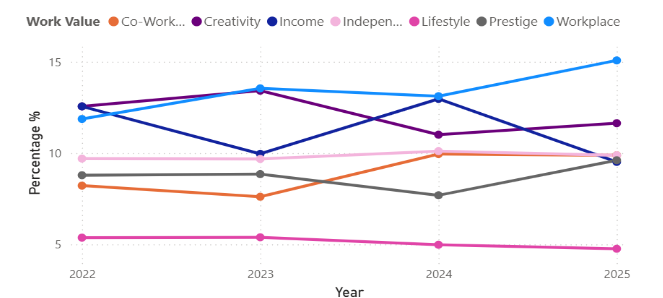
In the United States, work values are distributed across a relatively broad range of priorities, including workplace, income, creativity, and independence. One notable pattern is the fluctuation between income and creativity over time, suggesting an ongoing negotiation between financial considerations and self-expression. Independence remains a consistently stable priority, reflecting the importance of autonomy in career decision-making.
Workplace, in particular, appears to be expanding beyond physical environment to include psychological safety, such as expectations around respect, inclusion, and freedom from discrimination or harassment. This suggests a broadening interpretation of what individuals consider essential to a quality work environment.
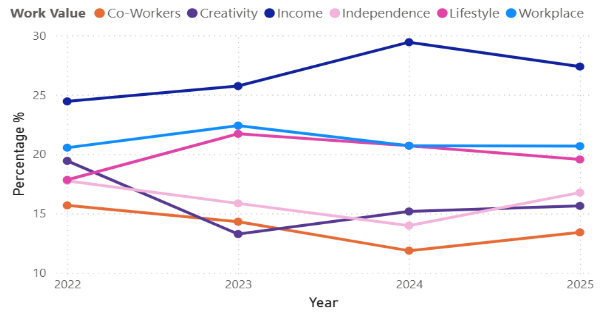
In China, income- and lifestyle-related considerations appear to be prioritized more consistently than other values. This suggests a stronger emphasis on financial security and broader quality-of-life considerations as central organizing factors in the evaluation of work. While values such as creativity and independence remain present, they appear to fluctuate more and occupy a secondary position in comparison.
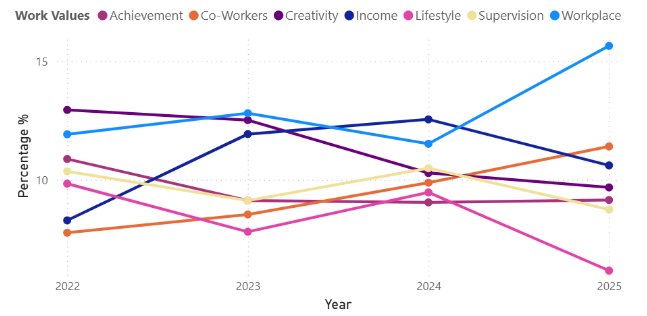
In the Philippines, workplace environment and relationships with co-workers emerge as consistently important considerations in work value patterns. Income shows variability over time but does not dominate the overall structure in the same way. This pattern suggests a strong orientation toward the social and environmental dimensions of work, alongside considerations of achievement and career progression.
While these patterns differ across regions, a shared insight is evident: work values are not fixed traits. They are shaped by cultural, social, and economic contexts, and they reflect how individuals make meaning of work within those environments.
For practitioners, this has important implications. Work values should not be interpreted as universal benchmarks or isolated preferences. Instead, they should be understood as contextually shaped indicators of how individuals are navigating their career environments.
Effective interpretation requires moving beyond surface-level comparisons toward a more nuanced understanding of meaning. The same value, such as “income” or “security”, may carry different implications depending on cultural context and lived experience.
This also highlights the importance of inclusive career development practice. Rather than assuming shared definitions of desirable work, practitioners can support individuals by helping them articulate and reflect on their own value hierarchies. This includes exploring tensions between competing priorities, such as income versus meaning, or autonomy versus stability, and recognizing that these tensions are a normal part of career decision-making rather than problems to be resolved.
Ultimately, career decisions are not simply the result of matching individuals to occupations. They are the outcome of a layered process in which culture shapes values, values shape priorities, and priorities shape decisions.
Understanding this chain allows practitioners to move beyond simplified models of career choice and toward more culturally responsive and context-aware approaches to supporting individuals in their career development journeys.
Authors
Paige McDonough, M.Ed., CCC, GCDF, is a Career Counselor with over 16 years of experience delivering career development initiatives across the US, Australia, and Qatar. She is currently the Senior Director of Career Development at Kuder, Inc., where she leads and supports training, thought leadership, and guidance on international and domestic partners
Joyce Tham is a Certified Career Services Provider (CCSP) who manages Kuder’s operations in Singapore. Her work includes supporting the nation-wide project with Skills Future Singapore since 2018. Aside to leading the Singapore operations, she also handles and guides Kuder Partners and clients all over Asia with their implementation of Kuder’s products and services. Users in Singapore have access to Kuder’s foundational assessments through the Skills & Workforce Development Agency here.
Table of Contents
